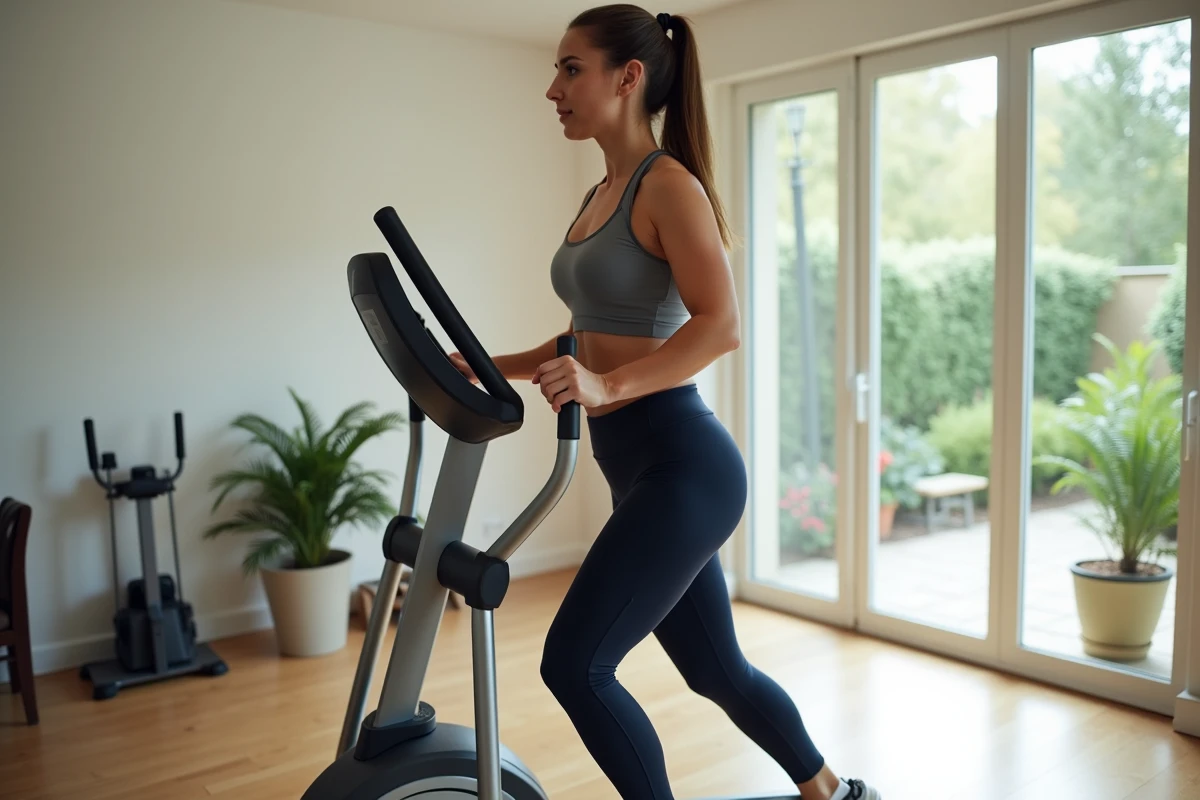
You place your feet on the pedals, grab the handles, and start pedaling. At first glance, the elliptical bike seems to require no technique. However, most users adopt a posture that limits their results and generates unnecessary tension. The position on an elliptical bike determines both joint comfort and muscular efficiency for each session.
Trunk Stability on the Elliptical: The Prerequisite That Guides Often Overlook
Before thinking about the resistance or duration of your sessions, pay attention to what is happening with your back. Many practitioners focus on the movement of their legs and arms, while the quality of the session primarily depends on the trunk.
When the deep muscles of the abdomen and lower back are not engaged, the body compensates. The pelvis sways from side to side, the lower back arches, and the shoulders rise towards the ears. These compensations often appear after a few minutes of effort, when fatigue sets in.
Protocols used in physiotherapy for returning to activity now include core stabilization work (planks, anti-rotation exercises) in addition to the elliptical. The goal: to strengthen the stabilizing muscles to reduce lumbar and cervical compensations during effort. This approach benefits both beginners and regular practitioners.
Specifically, before each session, consciously contract your abdominal muscles as if you wanted to bring your navel closer to your spine. Maintain this slight contraction while pedaling. Understanding the ideal position on an elliptical bike also involves this stabilization work, often overlooked in favor of mechanical adjustments.
Grip and Shoulder Tension: The Trap of a Too Tight Grip
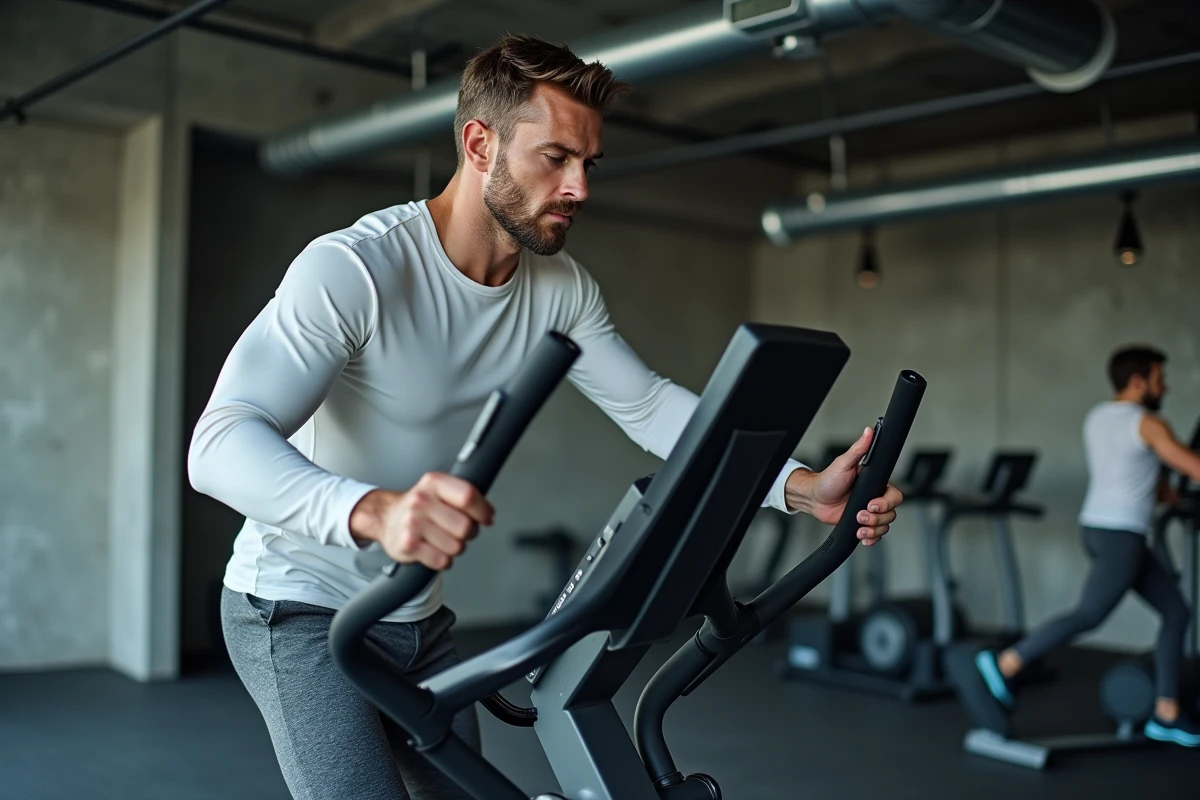
Have you ever noticed that your forearms feel tense after a session? This is a sign of a grip that is too firm on the handles. This reflex, common among beginners, triggers a chain reaction: the forearms tense up, the trapezius contracts, and the shoulders freeze in a high position.
Feedback from gyms indicates an increase in cervical tension and shoulder pain related to this tension. The answer is simple in theory, but more challenging to apply in practice.
Light Grip Technique
Your hands should wrap around the handles without squeezing. Imagine you are holding an open tube of toothpaste: firm enough not to drop it, but not so tight that the contents come out.
- Check every two or three minutes that your shoulders are low and relaxed, away from your ears.
- Alternate between the moving handles (those that move with your arms) and the fixed central handles to vary the muscular demands.
- On the fixed handles, completely relax your fingers for a few seconds at intervals to break the tension reflex.
This simple adjustment reduces fatigue in the upper body muscles and allows you to refocus the effort on the major muscle groups (quadriceps, glutes, lats) rather than wasting energy on unnecessary tension.
Foot Placement and Pressure on the Pedals: Avoid Overloading the Toes
On an elliptical, the entire foot rests on the pedal. In practice, many people concentrate the pressure on the front of the foot, as if they were walking on their toes. This habit overloads the toes and metatarsals, causing numbness and disrupting the movement.
The Heel-Stuck Rule
The heel remains in contact with the pedal throughout the push phase. This is the most reliable indicator to ensure correct support. When the heel lifts, it means that the weight is shifting too far forward.
Position your feet well-centered on the pedals, with your toes slightly pointed outward (a natural angle, not forced). If your machine has retention straps, adjust them without tightening too much to maintain proper blood circulation in the foot.
Correct foot placement also alters muscle recruitment. With heel pressure during the backward phase of the movement, the glutes and hamstrings work more. With more pronounced pressure on the front of the foot during the push phase, the quadriceps take over. Playing with these pressures allows you to target different muscles without changing machines.
Resistance and Intensity on the Elliptical: Adjusting Settings to Your Posture
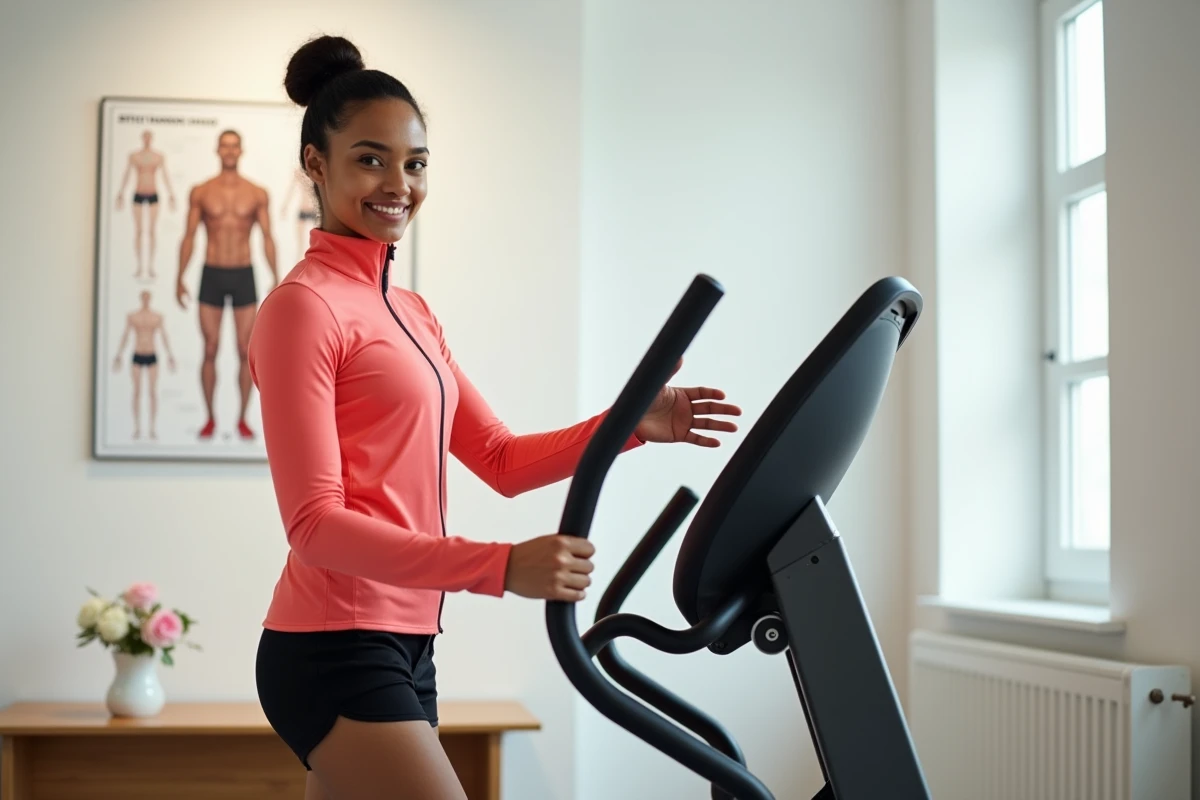
A resistance that is too low encourages fast pedaling, which disrupts posture. The body bounces on the pedals, the trunk loses stability, and the arms pull on the handles to compensate. Conversely, a resistance that is too high forces you to lean forward and strain your lower back.
The right setting lies between these two extremes. Why is this choice so crucial? Because the resistance directly affects the quality of your posture, not just the difficulty of the exercise.
- Start each session with moderate resistance for the first five minutes to find your alignment.
- Gradually increase in short increments. If your back curves or your shoulders rise, lower the resistance a notch.
- During high-intensity phases, keep your gaze straight ahead and your abdominals engaged to protect your spine.
The elliptical bike engages the entire body (leg muscles, arm muscles, core) as long as the resistance allows for controlled movement. A slow and controlled movement burns more calories than fast and chaotic pedaling.
Frequency and Duration of Sessions
Three sessions per week is a good rhythm for progressing without accumulating joint fatigue. The duration depends on your level, but maintaining posture remains the best indicator: when you can no longer keep your back straight and your abdominals engaged, the session has lasted long enough.
The elliptical bike offers a complete cardio workout with low joint impact. This combination makes it a fitness device particularly suited for returning to activity, rehabilitation, and daily physical maintenance. But these benefits only materialize if posture remains at the center of each session, from the first pedal stroke to the last.