Eight hours sitting in front of a screen, a lunch break squeezed into twenty minutes, then the commute home: when you get home with tense shoulders and a stiff lower back, the idea of putting on your trainers can feel a little abstract.
The challenge of fitting fitness into everyday life isn’t a lack of willpower—it’s the format. A program designed for someone who’s already on the move all day won’t suit someone who spends most of their waking hours sitting down.
Fitness routine for a sedentary job: start with the constraint, not the goal
We often start by setting a goal (running for 30 minutes, lifting a certain weight) when the real starting point is the day as it actually unfolds. For someone who works sitting down, the first constraint is the stiffness that builds up between 9 a.m. and 6 p.m.
French recommendations shared by info.gouv.fr clearly distinguish between time spent being physically active and time spent sedentary. In other words, breaking up periods of sitting matters just as much as working out. Getting up every 45 minutes to walk for two minutes isn’t a gimmick: it’s a distinct physiological benefit, separate from an evening workout.
Building a realistic routine means stacking two separate habits. The first, during work: break up sitting with regular short walks. The second, outside work: a short but structured workout, even if it lasts just 15 minutes. This approach of making progress in short blocks suited to real-life schedules is also reflected in Quel Coach’s fitness tips.
The classic trap is trying to make up for a full day of sitting with an intense evening workout. The two approaches don’t cancel each other out: you can train seriously and still spend too much time sitting the rest of the day. Treating these as two separate issues helps you avoid putting all your hopes on a single time slot.

Strength exercises to include each week
Everyday fitness is often reduced to cardio: brisk walking, running, cycling. Strength training takes a back seat, even though it deserves a place of its own. Public health guidelines pair weekly endurance activity with strength exercises at least two days a week.
For someone just starting out or returning after a long break, three movements are enough to work the whole body:
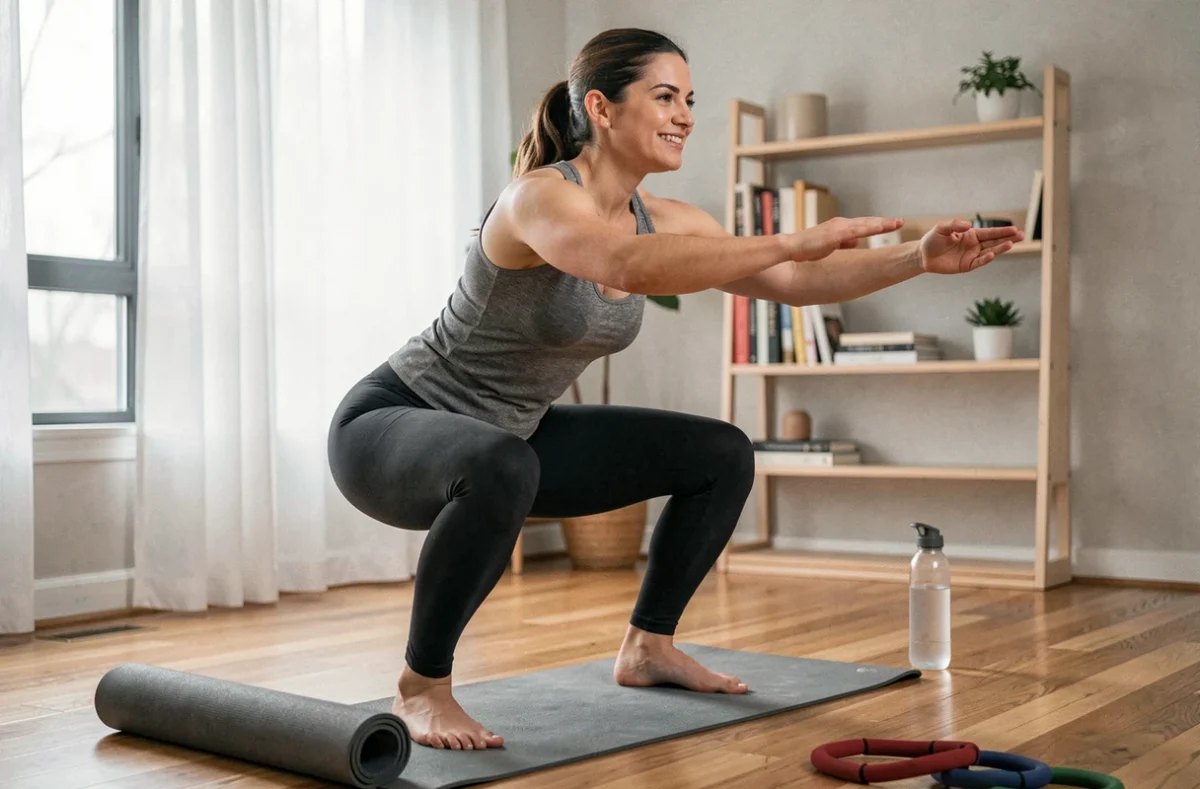
- Bodyweight squats (thighs, glutes): two sets of ten reps, making sure to lower until your thighs are at least parallel to the floor
- Incline push-ups against a sturdy piece of furniture (chest, shoulders, triceps): two sets of eight, keeping your core engaged and your back from arching
- Hold a forearm plank for 20 to 30 seconds (deep core): two to three reps, breathing steadily
This trio takes less than ten minutes. You can fit it in before your morning shower or just after work, with no equipment and no need to go anywhere. Progress means adding a rep or a few seconds each week, not changing exercises every three days.
When to increase the difficulty
A simple rule of thumb: when you finish the last set without any noticeable effort for two workouts in a row, step things up. For squats, you could add a weighted backpack. For push-ups, lower the incline. For the plank, hold it longer or lift one foot.
Progress doesn’t need to be fast. It needs to be consistent and measurable. Tracking your sets in a notebook or a basic app helps you see that your overall volume has increased over the course of a month, even if you don’t feel like you’re making progress from one day to the next.
Daily exercise motivation: what works beyond the first few weeks
Initial motivation often comes from a turning point (joining a gym, buying equipment, setting an appearance-related goal). That fuel runs out quickly. What keeps you going for months relies on different mechanisms.
Linking exercise to a set time of day turns a workout into a habit rather than a decision you have to make every evening. You don’t wonder whether you feel like brushing your teeth—you do it because it’s part of your bedtime routine. The same principle applies to fitness: tying it to a specific cue (right after your coffee, just before dinner) reduces the mental effort involved.

Another practical strategy: vary the format rather than the intensity. Fitness isn’t limited to the gym. Do a strength workout at home one day, take a brisk 20-minute walk the next, then follow an online class the day after. Switching things up helps prevent boredom without making planning more complicated.
The role of a workout partner
Working out with someone creates a social commitment that’s hard to break. When you’re on your own, cancelling costs nothing. But cancelling when someone is waiting for you at the park at 6:30 p.m. comes with a small social cost—often enough to get you to put on your shoes.
Your partner doesn’t need to be at the same level. They just need to share your time slot and commitment to showing up regularly. Comparing performance is secondary; it’s the shared consistency that makes the difference.
Adjust your fitness progress to your actual level
Following a program copied from the internet without adapting it often leads to one of two outcomes: either it’s too difficult and you give up after two weeks, or it’s too easy and you plateau without enough stimulus to improve.
The factor that varies most from one person to another is recovery capacity, which depends on sleep, work-related stress and diet. Two people of the same age and weight won’t respond the same way to three workouts a week if one sleeps six hours a night and the other sleeps eight.
Adjusting frequency before intensity is a principle that’s often overlooked. Four short, moderate workouts are better than one long, exhausting session followed by three days of inactivity. Total volume matters more than a single peak effort.
- Busy week at work: two 15-minute strength workouts and a daily walk
- Typical week: three 20- to 30-minute workouts, alternating strength training and moderate cardio
- Free week (vacation, working from home): four workouts, including one longer outdoor session
This flexible framework helps you avoid an all-or-nothing approach. The benefits of physical activity don’t begin only once you reach a recommended threshold: every session counts, even the shortest one. Moving for ten minutes on a difficult day is always better than doing nothing.
Everyday fitness progress isn’t measured by how many kilos you lift or your time on a route. It’s measured by how many consecutive weeks you’ve stayed active, in any form. That consistency, built around real-life constraints rather than an ideal program, is what eventually produces visible results.