The neo-Breton house, built between the 1960s and 1990s, is recognizable by its granite façade (or cladding), its doghouse dormers, and its slate roof. Renovating a neo-Breton house often reveals a solid structure but thermally outdated: concrete block walls lined with compressed glass wool, single-glazed windows, original electric convectors. The potential is real, provided that the right areas are addressed in the correct order.
Concrete block walls and air gap: understanding the construction system before insulating
Have you noticed that the walls of a neo-Breton house seem thick, yet thermal comfort remains mediocre? The explanation lies in their composition: an exterior cladding of stone or render, an air gap, and then a load-bearing wall of concrete blocks. The original insulation, when it exists, is limited to a thin layer of polystyrene or glued glass wool against the concrete block.
This system poses a specific problem. The unventilated air gap traps moisture between the two walls. Installing interior insulation without addressing this point amounts to trapping water in the wall. Capillary rise and condensation eventually degrade the new lining within a few years.
Before any intervention, a hygrometric diagnosis allows for measuring the humidity level in the masonry. If the wall is sound, internal thermal insulation (ITI) using wood fiber panels remains compatible with the structure, as this material allows water vapor to migrate.
If the site permits, the option to renovate a neo-Breton house from the outside (ITE) using wood fiber or expanded cork eliminates thermal bridges and preserves the living space, but it alters the appearance of the façade.
Wood frame extension on neo-Breton: gaining light without distorting
Neo-Breton houses share a recurring flaw: compartmentalized living spaces, a north-facing living room, and few large openings. Removing interior partitions helps, but does not solve the lack of natural light when the south façade is pierced with small windows.
The wood frame extension attached to the south or southwest gable is the most documented response by Breton architects in recent years. The principle: to graft a lightweight, largely glazed volume onto the main granite body, without altering the existing roof volume.
What this extension concretely changes
- It brings large south-facing windows, transforming the brightness of the living room or adjoining kitchen without piercing the original façade.
- The wood frame can be assembled in a few weeks, limiting the duration of the construction compared to a traditional masonry extension.
- The visual contrast between the wood (or contemporary render) and the old granite creates a clear architectural reading, often better accepted by urban planning services than an imitation of the existing.
A point of caution: the junction between the wood frame and the concrete block wall must be treated with particular care to avoid infiltration. A continuous expansion joint and an air-tightness membrane are essential at this interface.
Heating and underfloor heating: replacing the convectors of a neo-Breton
Most neo-Breton houses still operate with wall-mounted electric convectors, sometimes supplemented by a wood insert in the living room. This system consumes a lot and poorly heats large ground floor areas, often tiled directly on a slab without insulation.
Why are RGE artisans in Brittany increasingly directing towards air/water heat pumps? Because they power a low-temperature underfloor heating system, ideal for the large ground floor areas typical of neo-Breton houses. The heat diffuses from the floor, evenly, without the abrupt variations of a convector.
Conditions for the underfloor heating to work well
The original tiling usually needs to be removed. The slab is then insulated from below (or from above if ceiling height permits), and then the tube network is laid before a new screed. This intervention is substantial, but it simultaneously addresses the floor insulation and the heating system.
Coupling the heat pump and underfloor heating facilitates access to MaPrimeRénov’ and CEE aids, as the jump in DPE class obtained is often sufficient to trigger the most favorable amounts. Banks also now favor global renovation projects rather than isolated works post by post.

Granite and slate façade: preserving the architectural codes of the neo-Breton
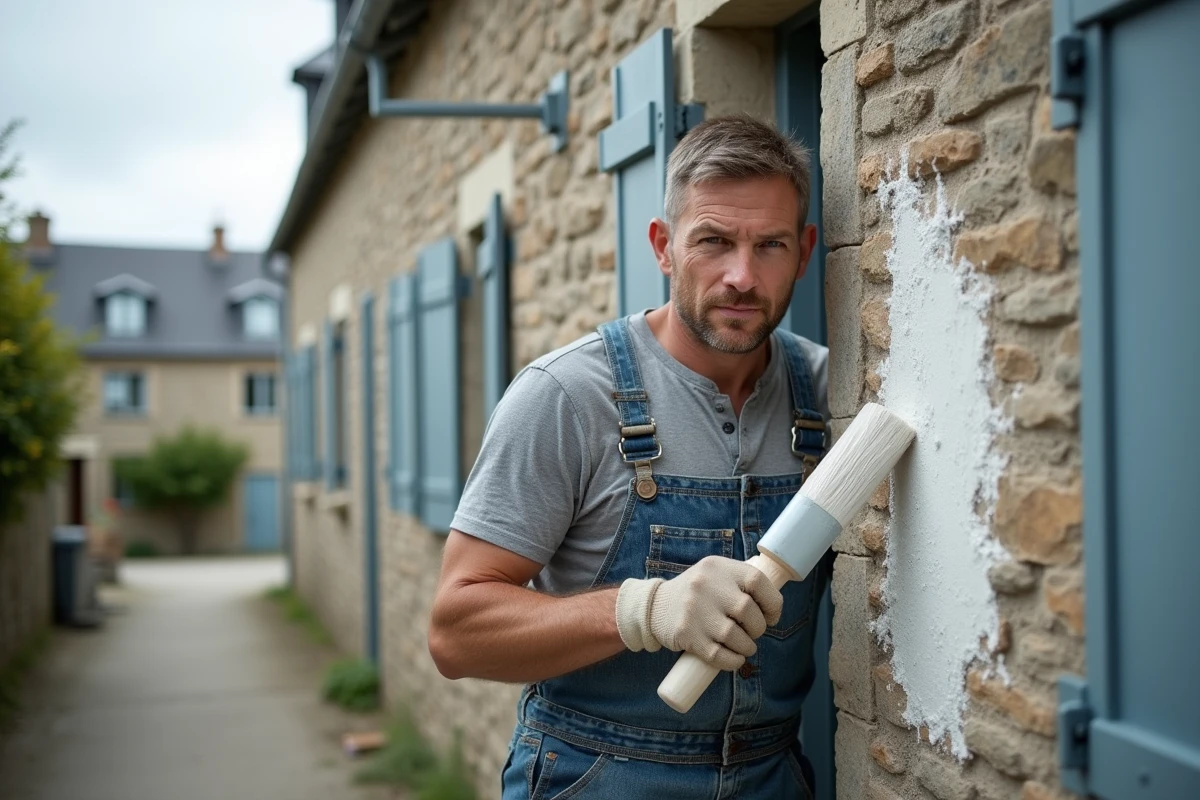
Granite and slate are not just decorative. The granite of window frames and plinths ensures mechanical resistance and a natural management of humidity that cement render cannot replace. When repointing is necessary, lime mortar (not cement) remains the only compatible option with granite, as it allows the stone to breathe.
For the roofing, natural slate ages well, but the original hooks and battens often show signs of fatigue after several decades. A roof replacement is an opportunity to add a breathable under-roof screen and to reinforce the insulation of the attic, two areas often absent in most original neo-Breton houses.
Renovating a neo-Breton house is not just a list of works. It is a balancing act between respecting an old construction system and integrating contemporary solutions. Addressing humidity before insulation, choosing extension rather than massive façade piercing, switching to underfloor heating rather than wall-mounted radiators: these technical choices, made in the right order, make the difference between a sustainable renovation and a project that needs to be redone in ten years.